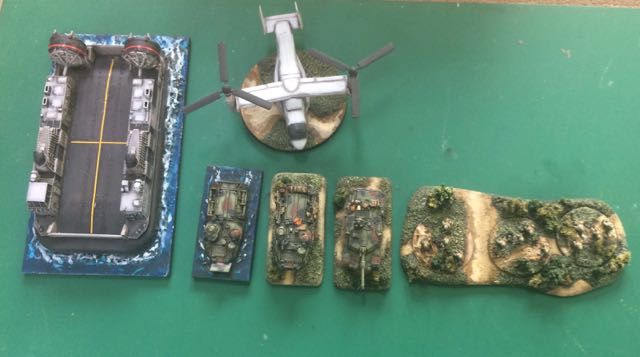
Welcome to Dragon Rising, Bear Resurgent , a blog I am using to record my Post Cold War wargaming projects. These are focused on expeditionary operations by Chinese, Russian, American and NATO forces in the post Cold War era, modelled and gamed in 20mm & 6mm. The blog includes links to various resources useful to the 21st Centuary Cold War Gamer.

Friday, 16 August 2019

ORBAT - USMC Marine Rifle Battalion


This post is part of a series that will examine the constituent components of a Marine Expeditionary Unit how they might evolve in the near future and their representation on the wargames table.  The capabilities and organisation of each will be presented in separate posts and the series will conclude with a look at the overall task organisation of the MEU. A MEU is a Marine Air Ground Task Force, the concepts associated with which are covered here.

The Marine Rifle Battalion forms the core of a Battalion Landing Team which is the Ground Component of a Marine Expeditionary Unit. The Battalion is also a key building block of the Ground Component in a Marine Expeditionary Brigade. As such it is probably an excellent place to start exploring the capabilities of a MEU in detail.


 The Organisation of the unit is covered in a number of USMC publications:
MCRP 1-10.1 contains a High Level outline of the organisation with organisational charts that document the structure to section level but does not include detailed composition. Detailed Composition and Organisational patterns for the task organisation of both the rifle companies and weapons company are contained within MCRP 3-10A.2. I have not managed to find useful detail on the H&S company although there is broad information available on the web on the Scout/Sniper platoon. Whilst MCTP 3-10A covers the Infantry Battalion it is significantly out of date and does not appear to be maintained as is MCRP 3-10A.4 the Marine rifle squad.
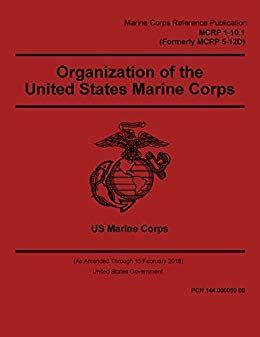


All USMC Publications can be downloaded for free from the USMCs own website from the Publications Electronic Library which is worth a browse.

I am currently building my forces for present day to near future operations with a focus on the Pacific. I  use  the  Cold War Commander rule set with 6mm figures and vehicles.  There is an excellent review of the rules here if you are unfamiliar with them.


These rules can represent units at 1:1 or at a more abstract Platoon level for larger games. I have used  a single base and single vehicle for Infantry and tank platoon. For support weapons I have used a group of 3-4 weapons which is generally a section but in some case needs a bit of interpretation as the USMC uses a number of concepts including, squads, sections and teams to describe these groups.

The fighting elements of the unit are contained within the 3 Rifle Companies and the Weapons Company. In addition there is a Headquaters and Supply Company which has some elements that are worth considering.


Headquaters and Supply Company.  The Wargames components of this organisation that need  representation are:
  • Bn HQ
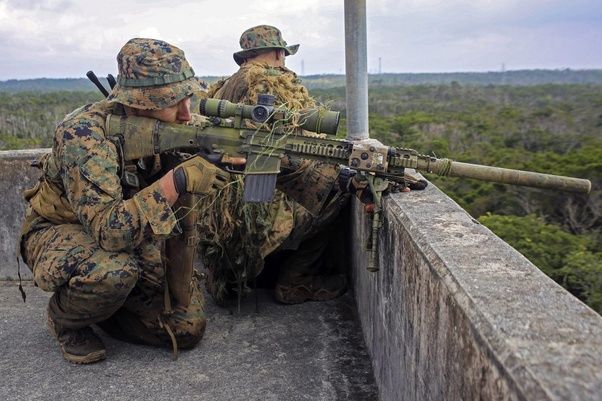
  • Scout Sniper Platoon. 
  • Medical Platoon
The Bn HQ and the Medical platoon are each represented by a single stand.  The Scout/Sniper Platoon is more of a challenge to tie down organisationally. MCRP 5-12D notes that it exists, MCRP 2-10A.6 Ground Reconnaissance Operations sets out its primary role to provide timely surveillance, tactical data and coordinate supporting arms and close air support whilst providing the Unit with Extended area observation underlining the reconnaissance aspects of the platoon.

A 1999 TOE identifies a small head quarters and 4 4 man scout/sniper teams each capable of deploying 2 Sniper Pairs. The platoon is generally commanded by the assistant intelligence officer and is part of the intelligence section.  A variety of insertion methods can be supported, from Rotary wing aircraft to small boats, or wheels. Vehicles are not organic to the platoon but are provided as needed from Battalion MT or Logistic Units.  The Platoon can be tasked directly by the battalion or task organised with the companies and other elements of the battalion.
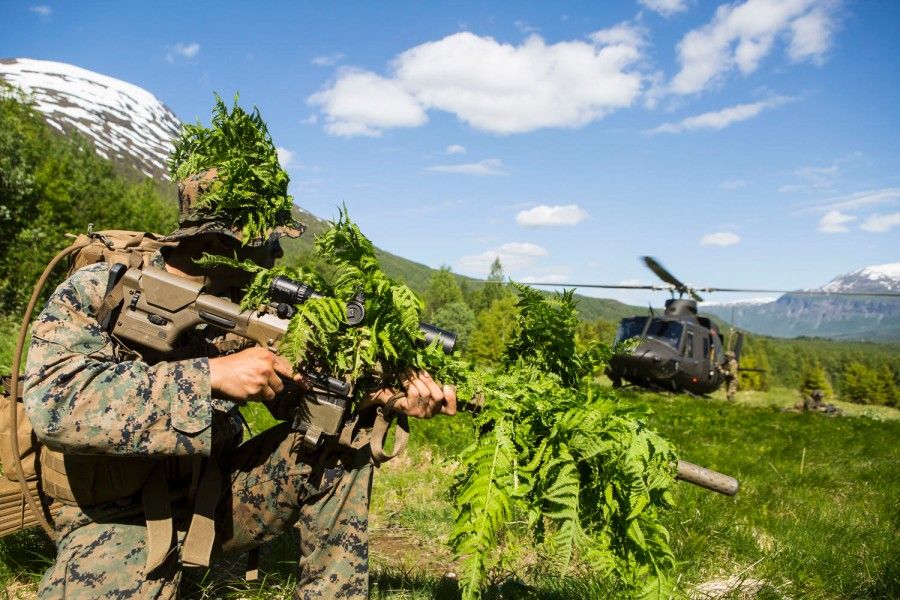

In addition to providing a reconnaissance capability they can act as snipers in both the anti material or anti personnel role using any of the in service sniper rifles:
  • M40A5 bolt action rifle being replaced by the Mk 13
  • M107 Barrett anti materiel rifle
  • Mk 13 Mod 7 Sniper Rifle
For game representation I am treating the sniper capability as a support weapon and will use them as two sections of 4 snipers.  I mount Support weapons on two figure bases and I am using two 2 man support weapons bases to represent the platoon and depending on scenario and task organisation will provide them 2 HMMWV for transport.

Marine Rifle Companies.  The Battalion has 3 Marine Rifle Companies each  organised as outlined below.
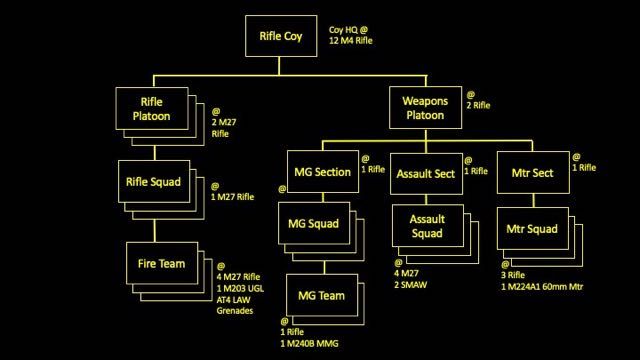

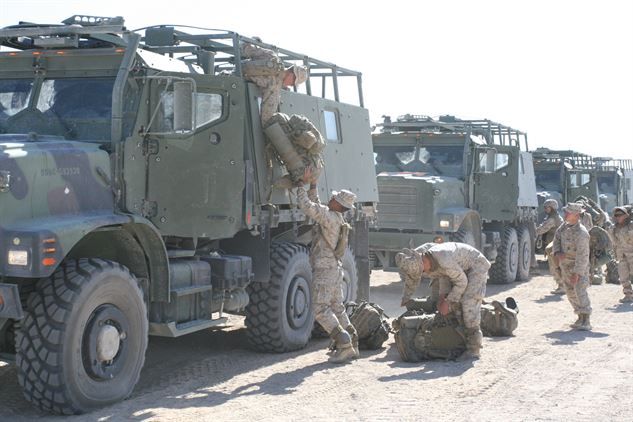
The Marine Rifle Company is essentially a light Infantry organisation. It can be task organised with a variety of transport assets provided by other units to enhance both its protection and mobility these include:
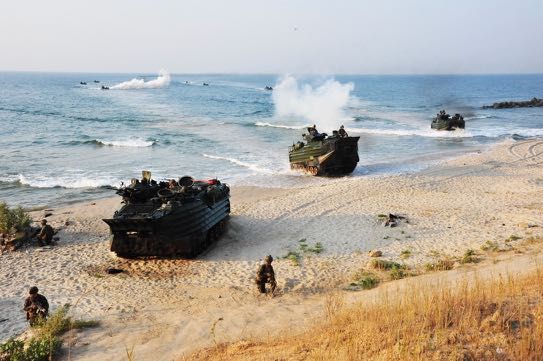
  • AAVP 7 or ACV 1.2 from the Divisions Assault Amphibious Regiments
  • MTVR from  the Transport & Support Companies of Combat Logistic Battalions
  • Small Boats from Navel CORIVRON units, Ship RHIBs or Marine CRRC
  • Rotary Wing inserted by Marine OV-22, CH53 or UH-1Y Venoms


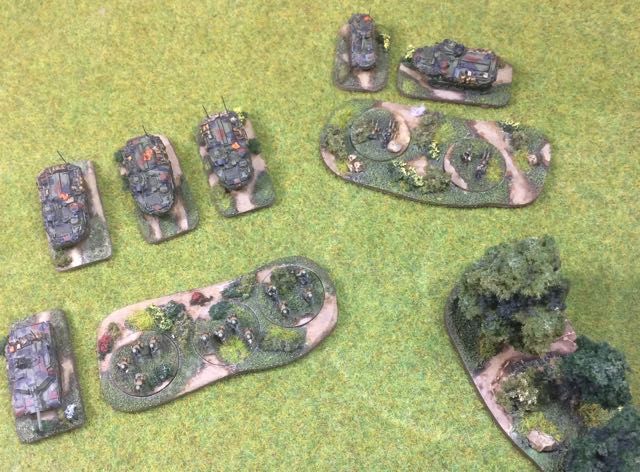
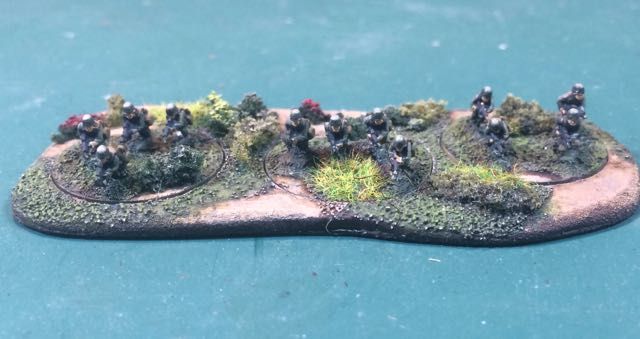
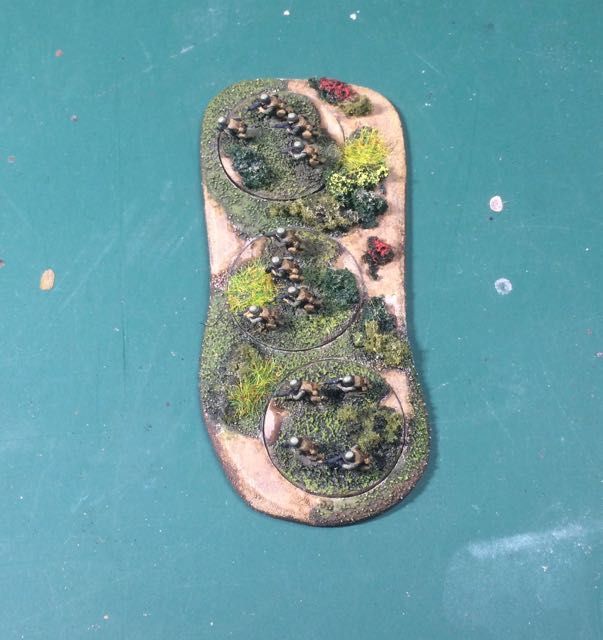
I have represented the rifle platoon using a triple slota base carrying three bases of 4 figures, effectively representing each squad. This offers the flexibility to play at a lower level or use a smaller footprint to represent the platoon in denser terrain such as urban environments where I could reduce to a single 4 man base, and of course they look good. 

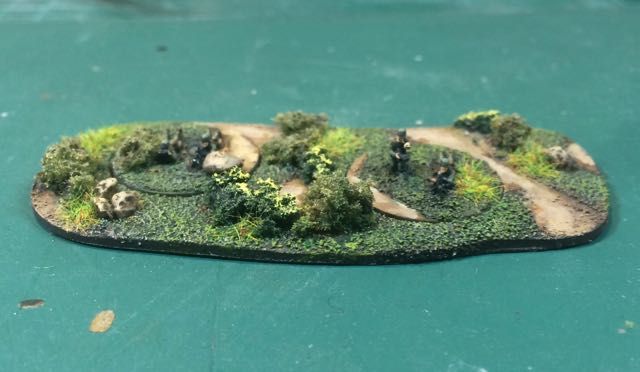
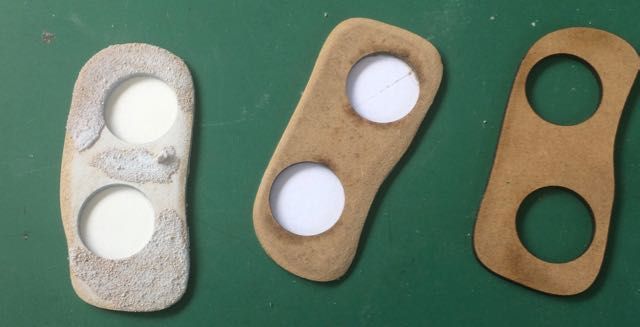
The weapons platoon can be task organized to the platoons or grouped centrally  depending on the mission need. I have represented each section with a single base of 2 figures and have them mounted in double slota bases with the company HQ primarily for ease of movement.  A Double slota bases is illustrated below.


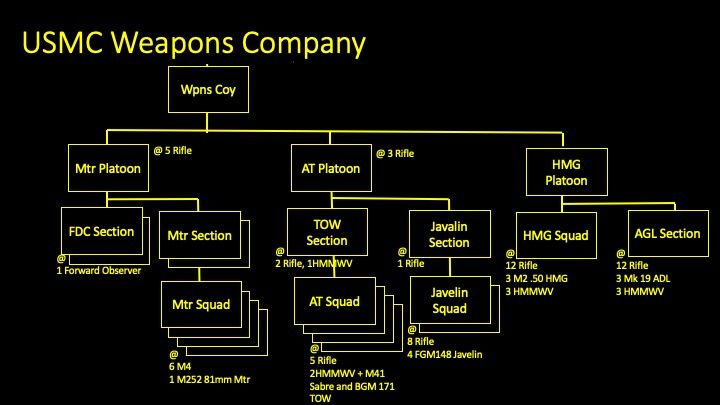
Weapons Company.  The Weapons Company provides an HQ and 3 Support Weapons Platoons, Mortars, Machine Guns and Anti Tank. Some battalions also include the Scout Sniper Platoon within the weapons company.


The USMC have a number of standard patterns for task organising the Weapons Company outlined in MCRP 3-10A.2 these are:

Combined Anti Armour Platoon. This organisation combines the Anti Tank Platoon and The HMG platoon and creates a CAAT Platoon out of the HMG, AGL and TOW Sections.  The Platoon is made up of two Combined Anti Armour Teams. The CAAT organisation is flexible and can be evenly split between anti tank and HMG/AGL sections or biased to one capability or the other creating light and heavy versions of the CAAT Platoon. 


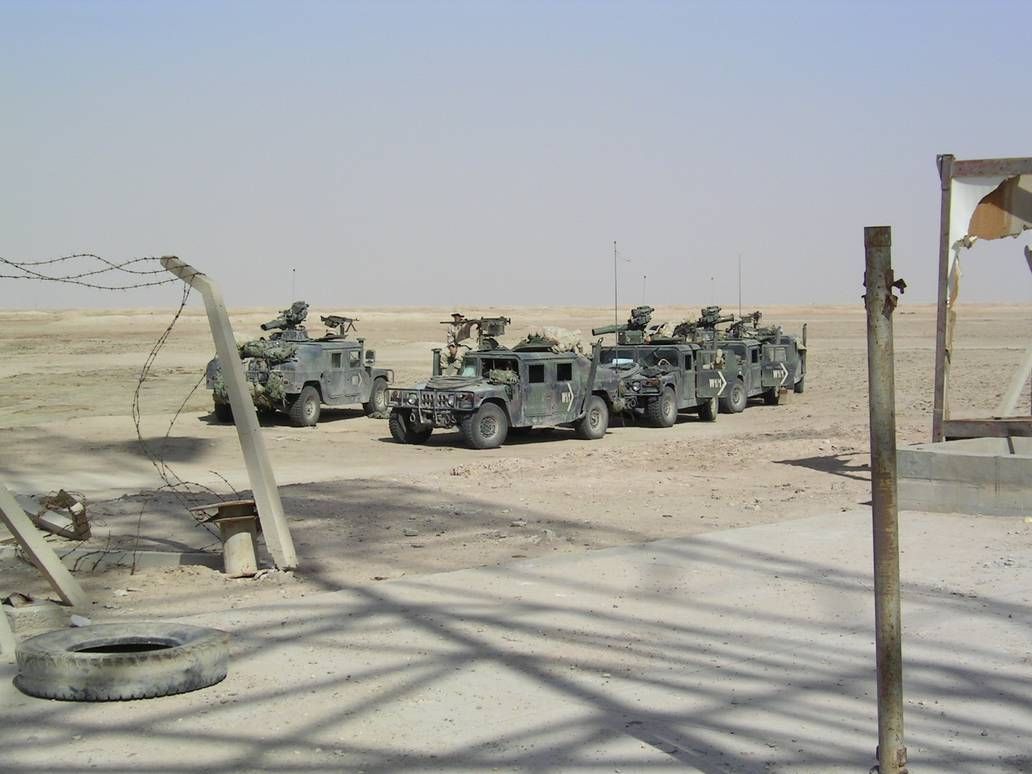
Mobile Assault Company. This task organised group converts a Mortar section into 2 HMMWV mounted maneuver squads each with 3 HMMWV. This can then be combined with an HMG/AGL Section and One or More TOW Squads to form a Mobile Assault Platoon. The Company can then be formed as Two Mobile Assault Platoons and a Fire Support Platoon of the remaining Mortar section.  This formation may be used when the Battalion needs a 4th maneuver company and is also useful for convoy escort.  Whilst vehicle mounted Scout/Sniper platoons are not covered in the Doctrine they would be an interesting addition to this concept.

The Company can also task organise CAAT Teams or AT Squads and HMG/AGL Sections with the rifle companies depending on mission need. The Javelin Squads tend to be task organised with the Companies as a matter of course. 


As can be seen the task organisation of the battalion is highly flexible allowing a wide variety of task organised mission groups to be created from the baseline organisation.

For the Wargames representation of the Weapons company I have stuck with the idea that 4 weapons represent a section as such I have represented the platoons as follows
  •  HMG Platoon with two 2 fig bases and 2 HMMWV, 
  • AT Platoon 
    • Javelin section as two 2 fig bases 
    • TOW section as two TOW Armed HMMWV, I have yet to find a dismounted TOW
  • Mortar Platoon as two 2 fig Mortar Bases and a 2 Figure OP Base and 3 HMMWV. (4 HMMWV if MAPs are created)
At this level both the Mobile assault company and the CAAT Platoon can be represented.


Future Developments:  I have been looking at the future development programs that impact the battalion and will deliver in the near future as I want to game using near future scenarios.  Of these programs it's a case of picking the ones that make an impact at a gaming level the following are of interest:
  • New Company and Squad Organisation, Equipment & Weapons.  The USMC are working through the restructuring of the Rifle Company and the squad this has yet to settle down in terms of numbers but has clear direction in terms of capability for both the company and the squad  and includes:
    • Operations and Intelligence Section in Company HQ
    • Systems Operators for Robotic Systems at Company and Squad Level,
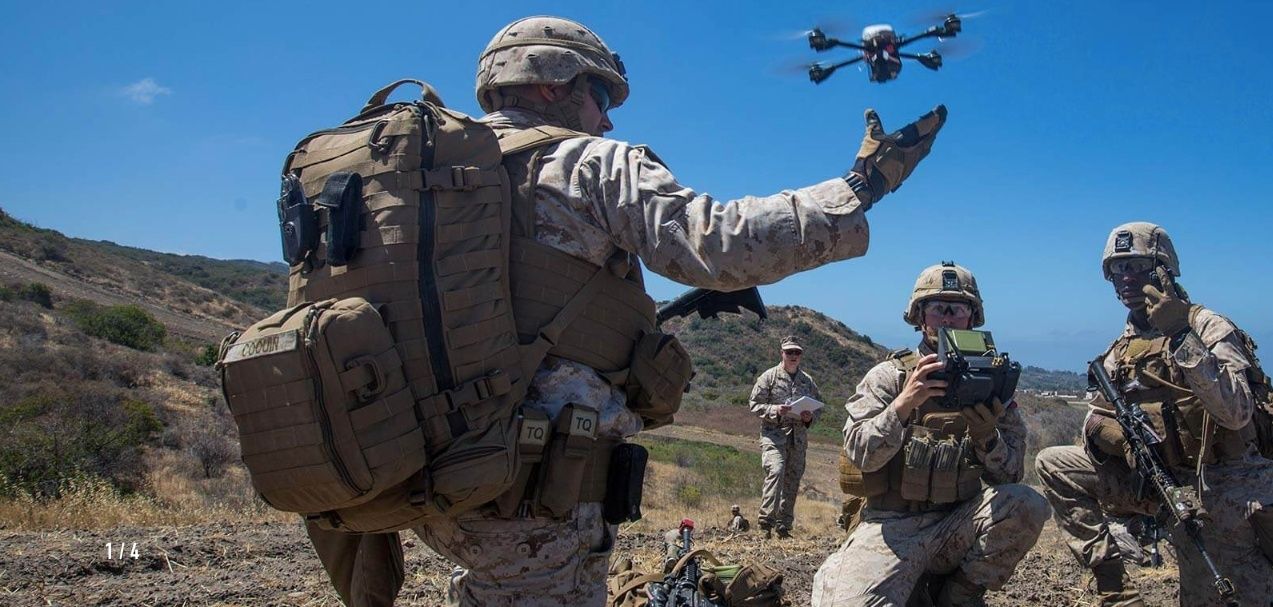
    • New Equipment at Squad level including Quad Copters, Range Finders, Upgraded Night Vision, Ruggedised Tablets
    • New personal equipment Body armour and communications
    • New Weapon Systems, M27 Rifles, M3 MAAWS, UGLs, Designated Marksman Rifle
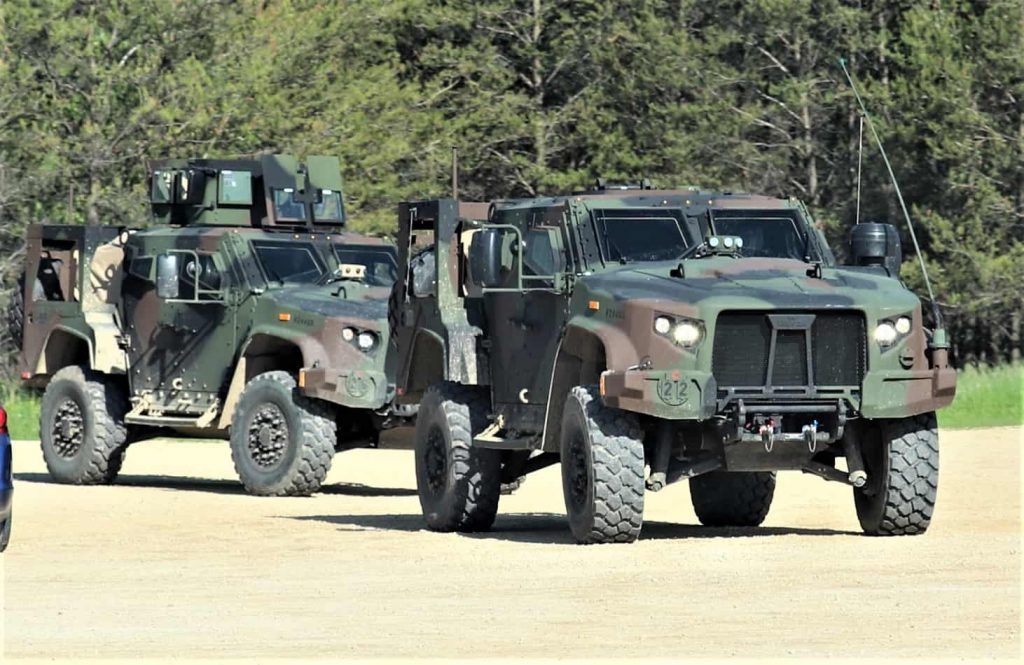
  • J- ATV. The Introduction of J-ATV to replace a proportion of the HMMWV fleet.  The hot question is, which bit? I am playing with a couple of assumptions, the first will be everything in the battalion and the second will be HMG and TOW only.
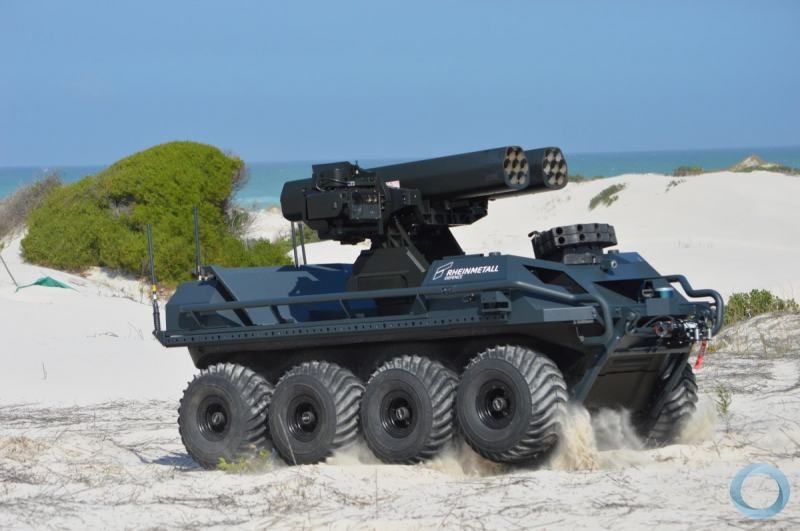
  • Robotics. The restructuring of the Marine Rifle Squad to 15 Men to include a Systems Operator and additional Systems operator roles in the Company HQ point to the increasing importance of  Robotics with UAV, Counter UAV and UGV being considered.  Of these the UGV will be difficult to represent as concepts are immature. UGV roles include heavy weapons, observation, load carriers, and sentries.  The Rheinmetall defence mission master platform below is an interesting example.
  • Anti Armour Restructuring. Phasing out of TOW Sabre and replacement with Javelin. This ones quite easy, the question mark here is how they will employ the Javelin teams mounted with a vehicle mount system or dismounted, I think I will go with the additional teams mounted on J-ATV.
  • More Electronic and Networked Functions moving further forward. an example of this is grouping EW Teams with Sniper teams.  Whilst the article discussed use with Scout/Sniper Platoons it would also work with Force Recon or the Recon Battalion. Game concepts would need to be developed but this typifies the way that different capabilities might be task organised in the future.
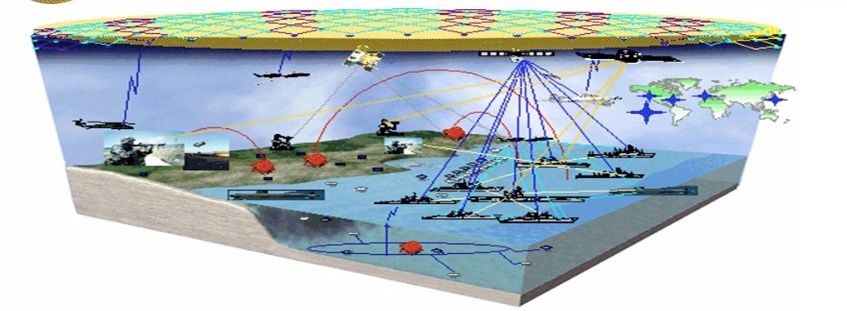
  • Representation of Network Centric Capability. Networked Sensors and precision guided munitions have proliferated dramatically in the early part of the 21st Century. The challenge really sits with up-dateing game rules and mechanisms to accommodate the technology.  This is fairly critical for the light weight force who will be relying heavily on the effects this can deliver.
There are a lot more forward looking program efforts and experiments being pursued by the Marines and I will be reviewing more as I examine the other capability areas.
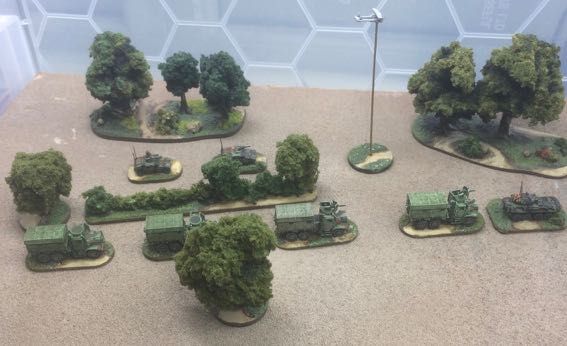

Figures and Vehicles. Everything needed for a USMC battalion is available from the major 6mm manufacturers. I have built this unit from GHQ figures using a mix of their current and cold war infantry packs. The only things that I have yet to find are:
  • Dismounted TOW (not a significant issue) 
  • 60mm Mortar (so my 81mm Mortars and 60mm Mortars all look the same)
  • SMAW figure, I am using a chinese infantry man carrying a PF89 on his back
The bulk of the modelling challenges come with pushing the unit into the near future such as creating UGVs and the specifics of TOW mounts on J-ATVs for example but I have yet to get stuck into that.


References:

Marine, Tom Clancy, 1997
MCRP 5-12D Organisation of the United States Marine Corps, Feb 2018
MCRP 3-10A.2 Infantry Company Operations, Feb 2018

MCRP 3-10A.4 Marine Rifle Squad, Feb 2019
MCRP 3-10A.6 Ground Reconnaissance Operations
MCWP 3-10 MAGTF Ground Operations
MCRP 3-30.1 Raid Operations
Amphibious Ready Group and Marine Expeditionary Unit
22nd Annual Expeditionary Conference
Cold War Commander Rules

Monday, 1 October 2018

ORBAT - USMC MAGTF


The purpose of this post was really to understand how the MAGTF concept worked at the high level and the overall forces that would be drawn from to bring that capability together before examining in detail the structure and composition of a Marine Expeditionary Unit in a later post.  The post looks at:
  • The MAGTF concept including the air and ground units that supply combat elements
  • Sealift and Naval support 
  • Aspects of the operational challenge in the Pacific
  • High level view of model scale and availability for Gaming


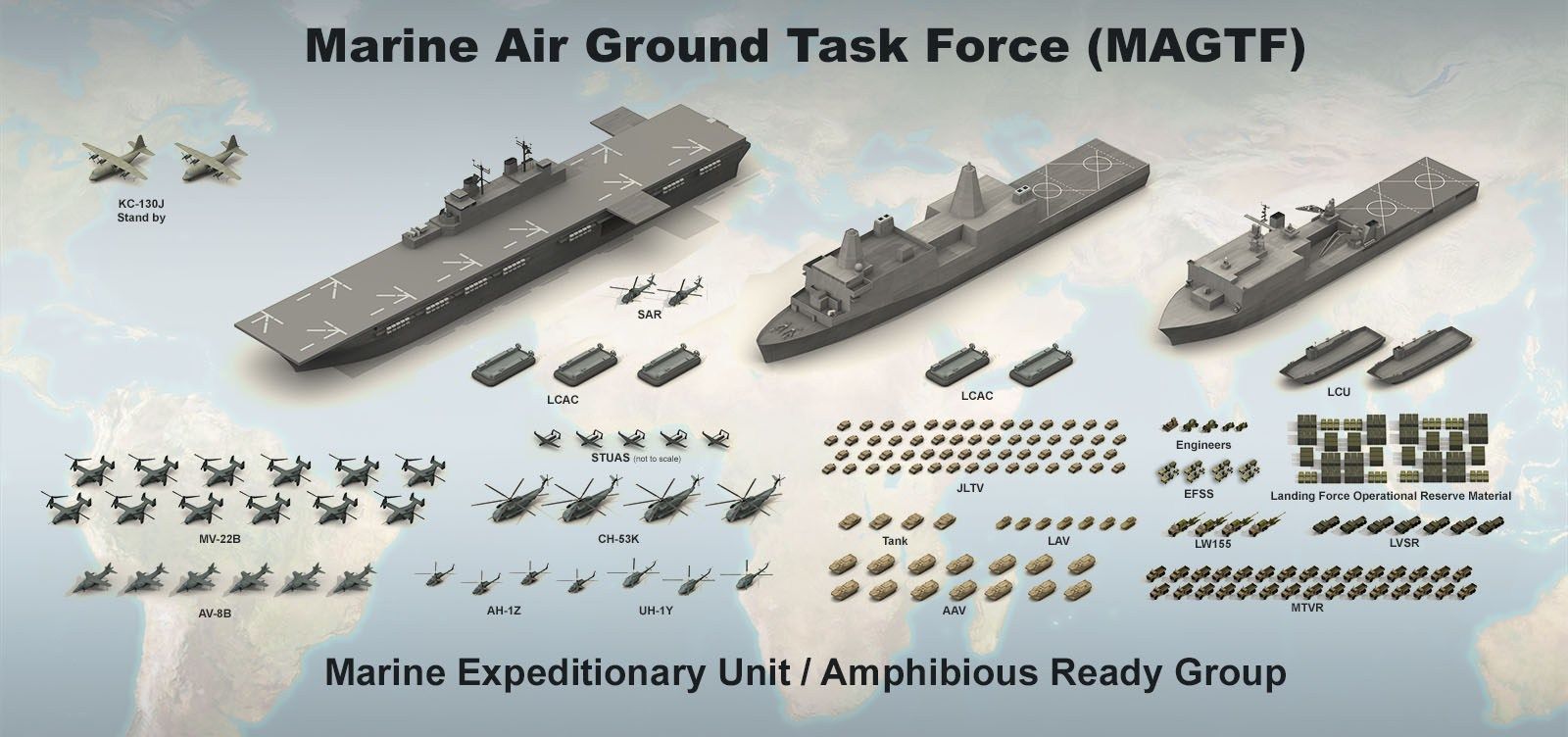
MAGTF Concept. The United States Marine Corps organises for Combat into Marine Air Ground Task Forces (MAGTF). whilst the MAGTF is built around USMC components and can stretch from a Platoon to a Joint USMC/Army Force or a Coalition force essentially it is described at three different organisational levels:
  • Marine Expeditionary Unit where a Marine Rifle Battalion is the lead component of a task organised combined arms Battalion Landing Team that forms the core
  • Marine Expeditionary Brigade where a Marine Rifle Regiment is the lead component of a task organised  combined arms Brigade Landing Team that forms the core 
  • Marine Expeditionary Force where a Marine Division is the lead component of a task organised joint combined arms or coalition ground force that forms the core.
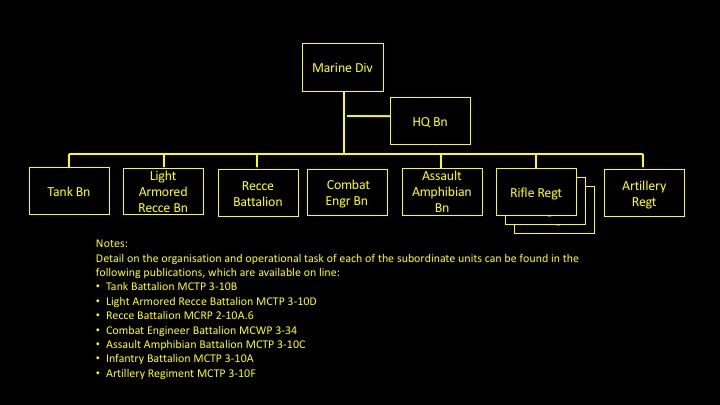
Task organised Combined Arms forces include attached elements to the core units from other arms such as Armour, Armoured Recce, Combat Engineer, Artillery, and Assault amphibian.  Joint forces include other Services such as an Army Stryker Brigade, Coalition Forces include elements of allied nations forces.

MAGTFs are task organised from components held within the Marine division and Marine Air Wings, whilst these can vary, generally they comprise:
  • Marine Division
  • Marine Air Wing

Regardless of the unit or formation it is based on the MAGTF is an integrated expeditionary combined arms force and is formed of four task organised force components.
The MAGTFs Components fulfil the following functions:

Command Element. Is the MAGTFs HQ it organises a holistic battle involving the integration of all three components to achieve the mission aim. It will plan and execute missions based  on the USMCs doctrine which is essentially manouverist and will therefore tend to focus on the destruction of the enemy rather than taking and holding ground.


Ground Combat Element.  Is a task organised force that provides the capability to undertake Ground combined arms manoeuvre. It works as an integrated component of the MAGTF not a separate entity. It covers amphibious, offensive, defensive and stabilisation operations. Its key capabilities are:
  • Ground and Amphibious Reconnaissance, 
  • Combined Arms Ground Manoeuvre and security
  • Massed Firepower
  • Close Combat
  • Seizing and Holding Key Terrain

Aviation Combat Element. Provides all 6 functions of USMC Aviation and varies in size from an aircraft detachment to multiple Marine Air Wings.  It works as an integrated component of the MAGTF. The 6 Functions provided are:
  • Offensive Air Support
  • Anti Air Warfare
  • Assault Support
  • Air Reconnaissance
  • Electronic Warfare
  • Control of Aircraft and Missiles


Logistic Combat Element.  Provides the Combat Service Support Function it can vary in size from a platoon to multiple logistic groups and covers;
  • Supply 
  • Maintenance, 
  • Transportation, 
  • General engineering, 
  • Health services 


The MAGTF strikes me as one of the most tightly coupled joint forces in existence, with dedicated land and Air components in a single unified command, that the level of task organisation and the potential to model a variety of Naval assets is what really grabs my imagination.  

Sealift and Naval Support.   The Sea lift and Naval support assets provide a degree of context during the game and selected elements of the Naval engagement could be played out. Like air landing operations these need to be controlled if the main event is to happen.  Although there are a variety of deployment options with varying components of sea lift I am primarily interested in over the beach operations. At the battalion level the Sea Lift component of this is an Amphibious Ready Group comprising:
  • An Amphibious Assault Ship LHA/LHD
  • An Amphibious Transport Dock LPD
  • A Dock Landing Ship LSD
  • Its embarked MEU


This can be task organised with a Surface Action Group and or a Littoral Combat Group to form an Expeditionary Strike Group which in turn can work under an umbrella provided by a Carrier strike group.  When working in conjunction with a Carrier Strike Group you would expect that a greater component of the MAGTFs embarked air assets could focus on the ground mission whilst the CSG focuses on the Air Superiority and Force protection aspects.


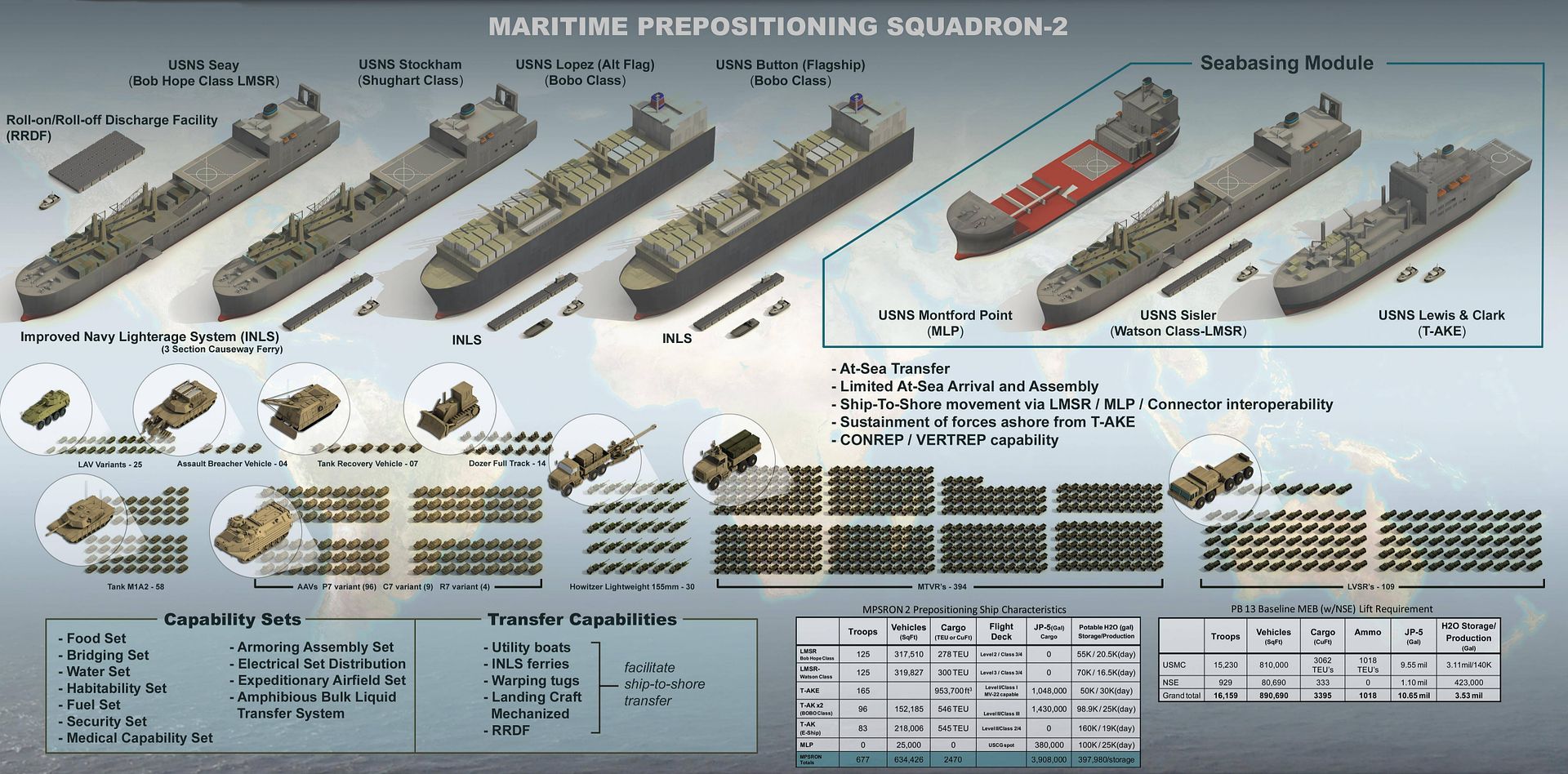
If deploying a Marine Expeditionary Force, it seems likely that  the fleet elements would need to be supplemented with components provided by the Maritime Pre Positioning Force from the various MPSRONs. The numbers of LHA/D required to put a MEB over the beach being 50% of the current fleet of 8 LHDs and 2 soon to be 3 LHAs this fleet would seem to give a potential maximum deployment capacity of 2 MEBs. Given the number of permanently deployed MEUs and maintenance cycles this would be interesting to achieve and would take planing and time. If the division has more than two Brigade Landing Teams then it seems likely that the 3rd would have to call upon an MPSRON, the pre conditions for that would be a degree of security or a port I suppose. The alternatives are getting imaginative around Ships Taken Up From Trade in a manner similar to Op Corporate.

The US Navy is currently aiming to have a fleet of 36 Amphibious ships by 2021, with a number of 38 being identifies as that required to land 2 MEBs and allow for maintenance, whilst 50+ is the number talked about to land an MEF with 3 Brigade Landing Teams.


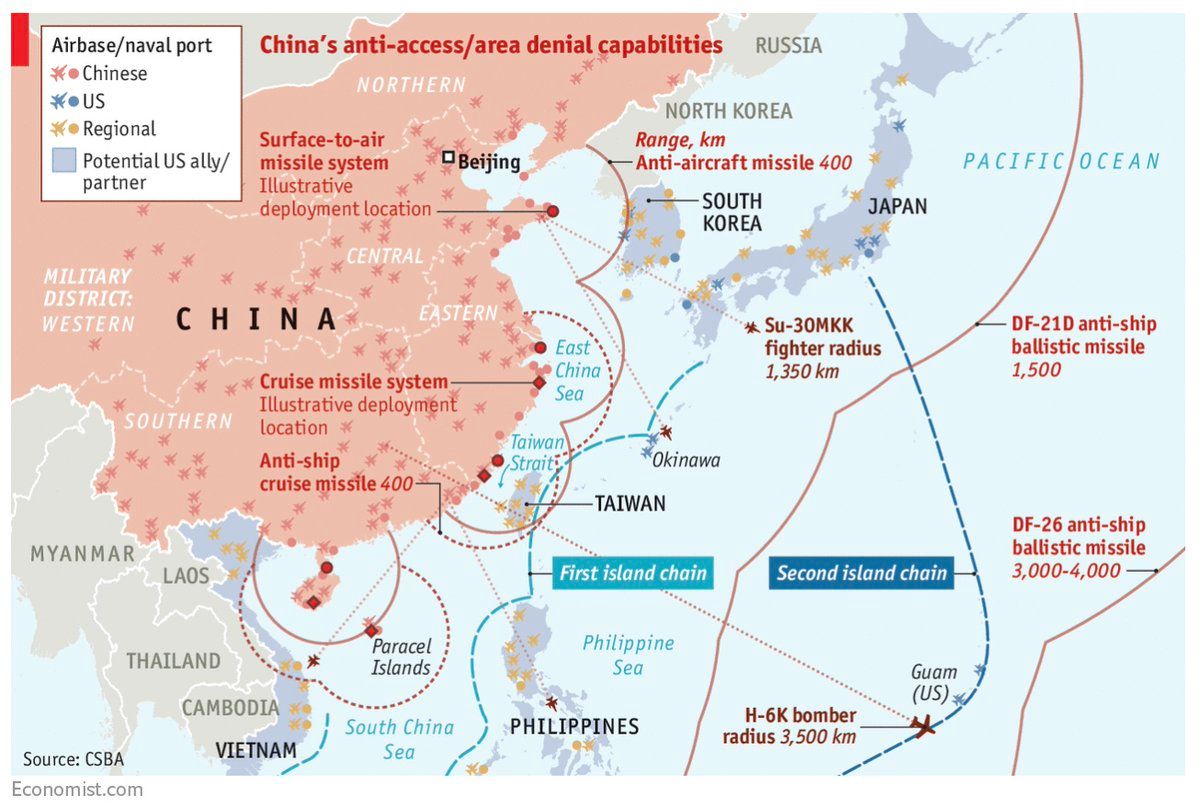
Operational Challenges Of course concentrating this level of force in order to undertake landing operations forms what many would call a large target. Given China's evolving Anti Access Area Denial (A2/AD) capabilities covering the South and East China Seas which include;
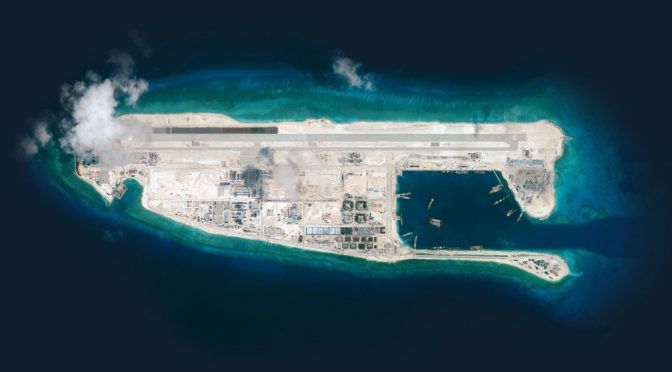
  • Island Bases
  • Land based Ballistic Anti Ship missile capabilities, 
  • Missile Attack boats
  • Expanding Diesel Attack Submarine fleet
  • Land Based Aircraft
These A2/AD capabilities pose increased challenges to landing operations in contested littoral environments around these areas, however like the Cold War ATGW threat the balance of capability and advantage will probably see saw around this one for a while.


The Map below illustrates the challenge quite nicely. Traditional Landing operations are conducted from upto 12 Miles offshore, concepts for high speed ship to objective maneuver talk to 100 miles neither of which really tackles the issues illustrated which suggest a need to:

  • Target and engage the land based assets effectively with either Kinetic effects or disruptive attacks such as EW.
  • Provide adequate defence of the landing platforms. 
  • Increase the stand off and dispersion.


Wargames Goal  So my goal is to create a  6mm 1/300 force focused on a MEU MAGTF but that could stretch to a MEB at a more representational level, 1 Vehicle represents a platoon, 1 Ship a group of ships. Currently I am looking to build out the;
  • Ground Combat Element, 
  • Air Combat Element 
  • Naval support Elements probably to the level of the ESG, although a Carrier strike group would be nice, it might be a step to far and pose a major storage challenge.
This force will be used for current and near future games set in the Pacific with the Chinese initially providing the principal opposition. Over time I fancy it could open up to include US Army and Coalition partners of which the most interesting are the Australians although I have yet to really examine any of the other coalition partner options in the region. 


Model Availability

I think of the scale as around 1/300 as to get full coverage of the force components I am looking at:
  • Ground forces 1/285 (Primarily GHQ)
  • Air Forces 1/350 (Primarily Trumpeter)
  • Naval Forces 1/350 (Primarily Trumpeter)
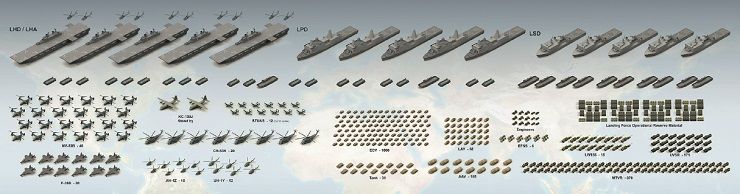
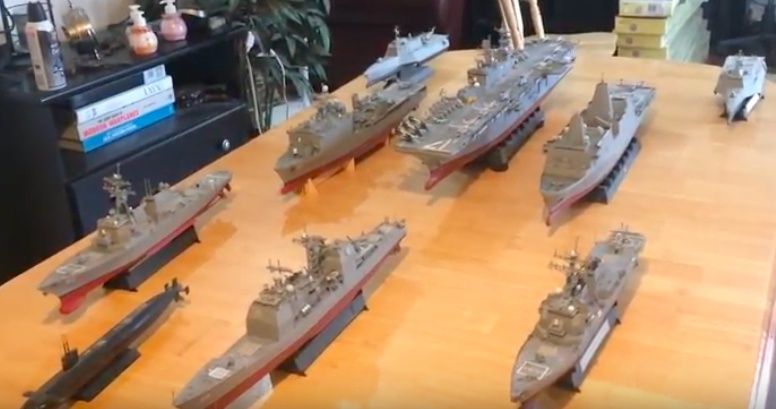
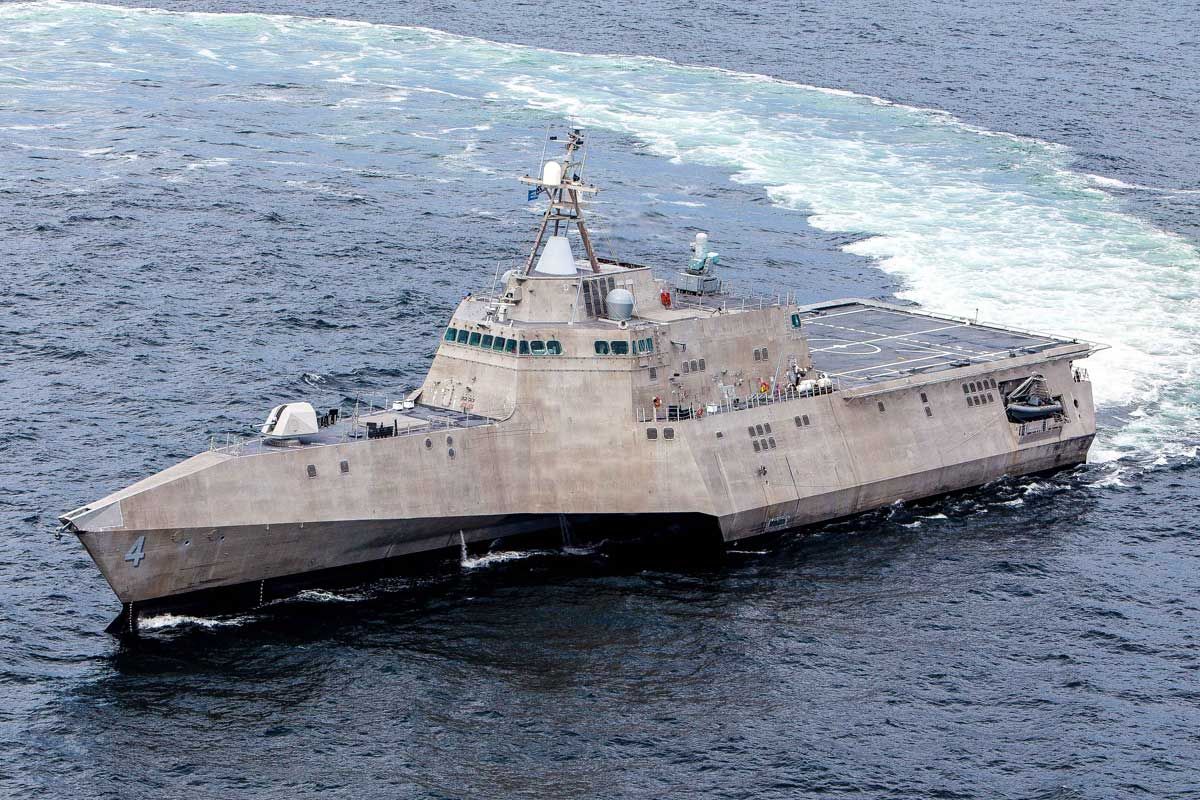
The aspiration on the Naval side would be something that looks like the image below from Jeff Heads 1/350 Scale Model Building and Defence Youtube Channel but waterlined, I will need to work out how they play into the game other than as a sea base and potentially some novel ideas for submarines.


The next articles in this series will examine the composition of a Marine Division and a Marine Air Wing in a little more detail in order to understand the range of components that could be task organised for a USMC MEU, before looking at a representative MEU in detail.


References:

Saturday, 29 September 2018

Modelling - A Basing Philosophy for 6mm Figures and Vehicles


Having switched scales I have been re-evaluating my approaches to a number of common modelling tasks that I was generally happy executing in 20mm.  The first covered in my last post, was stowing vehicles,  the second covered in this one is my philosophy for basing.  I had intended to include this with a model review but soon realised that the level of change warranted a more detailed piece of its own, if only to set out an approach for me to follow as the project developed.


I have always been a firm believer in baseing vehicles which;
  • Protects the model when handled.
  • Makes them look good
  • Reduces the effort in moving lots of infantry around the table  
I always think these factors outweigh the negatives which I tend to think of as:
  • The base does not always match the terrain
  • They take up more space for storage 
  • They raise the model up from ground level.
Elements of the negatives are also more easily managed in this scale as the costs of the models are significantly less than in say 20mm, so you could have multiple versions of the same model on different bases for instance, although I think I'd draw the line between a complete set of Urban and Rural based vehicles although I am considering it for the ship to shore elements and some aircraft.


Base Thickness. I like Laser cut MDF bases which are very easy to use, though in this scale there are challenges as the thickness of the bases tends to be around 2mm which is 33% of model height as opposed to 10% of model height in 20mm.  

To counter this I rounded the base corners and then chamfered the edge to reduce the visual impact of the thickness when the model is on the table.  For some of the bigger bases such as infantry group bases an electric sander is a blessing otherwise a sanding block and or sanding sticks are sufficient to the task.

The Infantry movement tray bases are a particular issue as they have a 2mm thick base which has a 2mm thick additional layer with the cutouts in on top.  I replace the bottom layer with cardboard which keeps the height increase to a minimum. Care needs to be taken when working the these bases to keep glue and baseing material away from the slots and the edges of the infantry bases.  The irregular shaped base elements left over by this approach are used for small groups of trees and scatter terrain.


Base Sizes. I think the models look better when you use consistent base sizes for different vehicle types even if the rules don't require it.  Currently for my 6mm forces I am using or considering using the following:
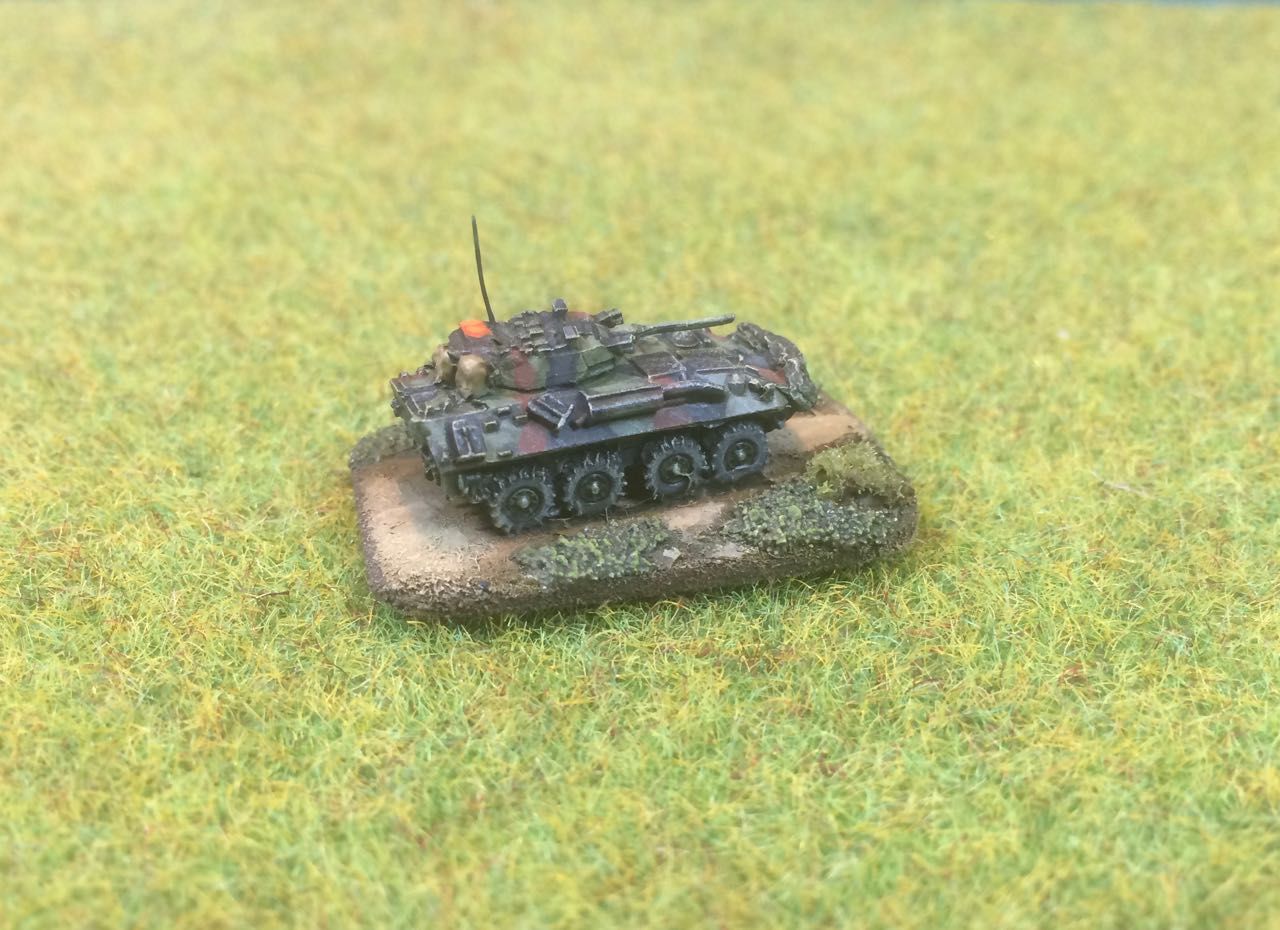
  • Large Armoured Vehicles, 40mm x 20mm
  • Small Armoured Vehicles, 30mm x 20mm or 35mm x 20mm
  • Large Soft Skins, 35mm x 15mm (yet to use this so may need revising)
  • Small Soft skins, 25mm x 15mm 
  • Aircraft Bases 40mm Diameter
  • Artillery Bases, 40mm Diameter
  • Infantry teams, 20mm Diameter
  • Infantry Group Bases, Irregular 2 and 3 team pill bases approx 40mm x 80mm


I get all my bases from East Riding Miniatures who are very quick and have a great range of sizes and in this scale that probably covers significant terrain components.  In addition they produce to a consistent quality.

Ground Work This of course is an area of personal taste but having modeled in 20mm for so long I thought the groundwork raised further challenges as the materials I had used in 20mm seemed like they would be disproportionate in size for 6mm.  Examples include:
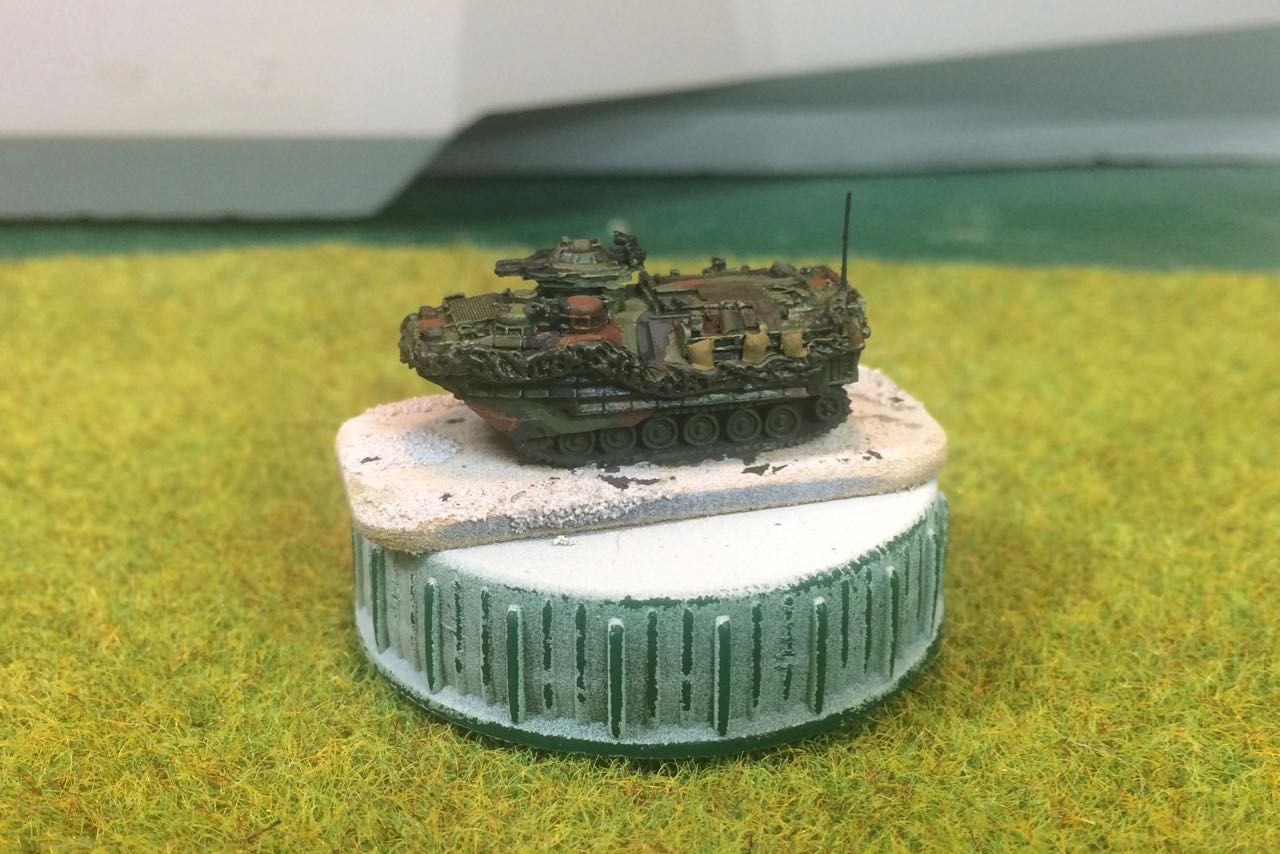
  • Static grass which is between 1mm and 2mm in length which in 6mm represent effectively very long grass rather than short grass
  • Sand particles which I use as texture for dirt surfaces in 20mm seemed to be similarly outsized. 

 I therefore decided to revise what materials I used and have outlined my thoughts below.


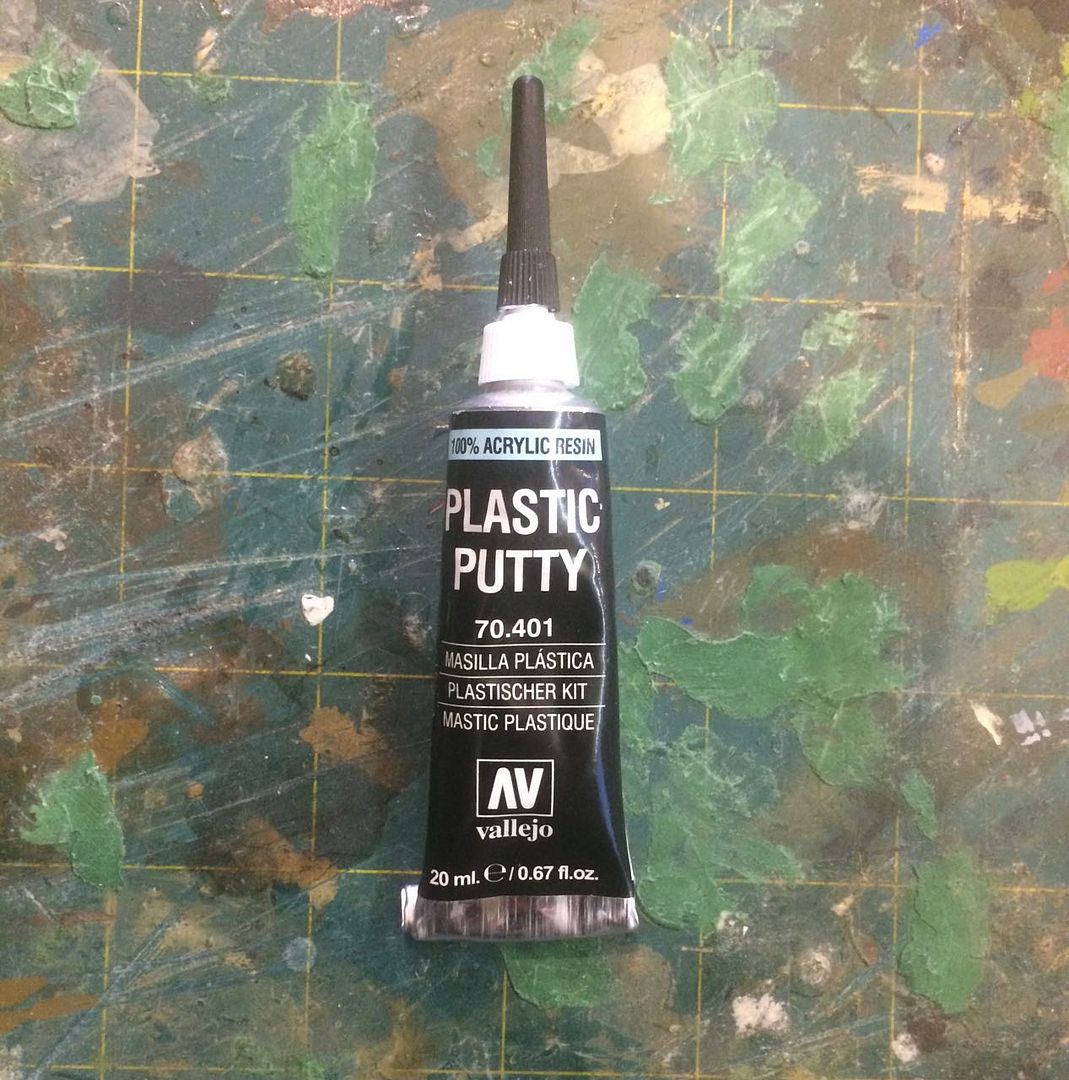
  • Dirt Surfaces, Instead of applying sand I just abraid the surface of the mdf base with sand paper to rough it up a bit and add small amounts of fine texture using my new universal best friend, vallejo plastic filler pipped on to the surface. Plastic filler can also be used to blend in the edges of infantry bases if they are on dirt rather than grass. Because of the long applicator nose this is easy to accurately apply.
  • Short Grass, Instead of static grass I am using fine sand particles applied on top of white glue. These can also be built up in layers to provide surface variation, I seal it with white glue once the effect has been created otherwise it eats paint.
  • Long Grass. Small clumps of static grass, short tufts (2mm) and Turf clumps any or all attached with white glue.

  • Shrubs and bushes, I use clump bush material divided into a variety of sizes; 1mm-  2mm for small shrubs and long grass and 6mm - 12mm for large bushes and hedges. I use a contact adhesive to attach it to the base, and then saturate it with white glue so it becomes hard. When the white glue has dried and the bush hardened  I then enhance shadow areas with dark green and highlight upper surfaces with buff or light green . These can also be dry brushed with bright primary colours to represent flowers.

  • Rocks.  I use a variety of material to represent rocks rough sizes are: fine ballest 1-2mm, fish tank gravel 2mm-3mm and garden gravel 4mm - 10m.  These are attached using a contact adhesive and painted, washed and dry brushed, with the ground around their base receiving a dark wash to represent shadow.
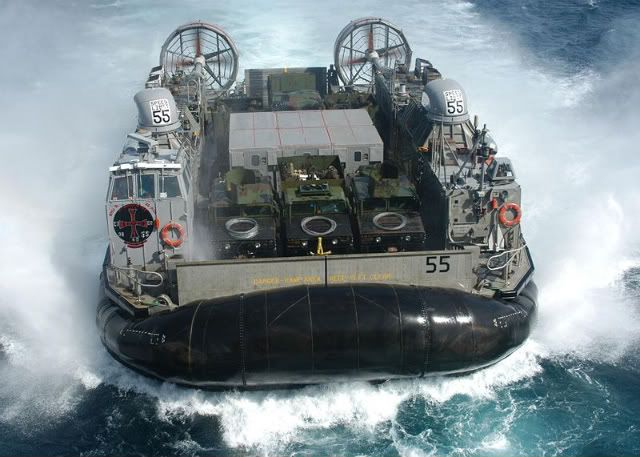
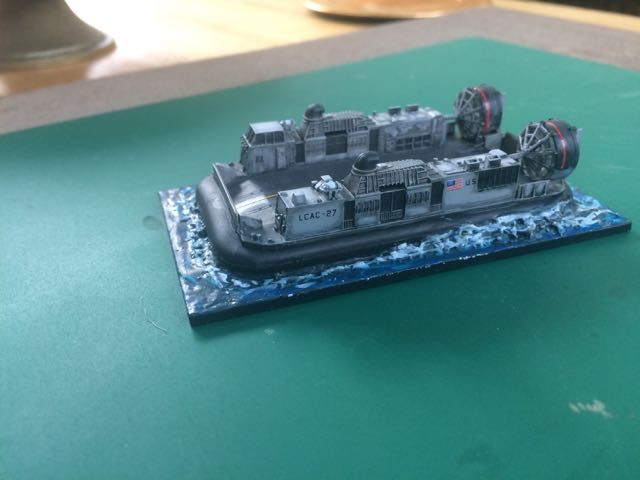
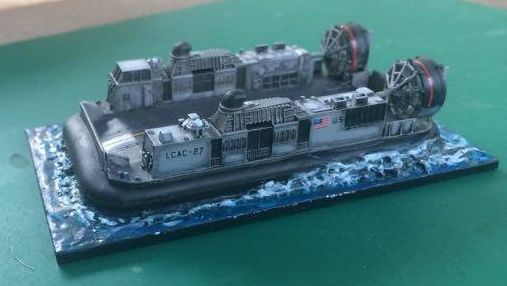
  • Sea and River bases. For representing broken water and surface ripples I use the Vallejo plastic filler again which builds up nicely in layers to represent the spray effects at the back of this hovercraft. Once it has dried I give the base a few washes of white glue to provide a smooth surface  before painting.
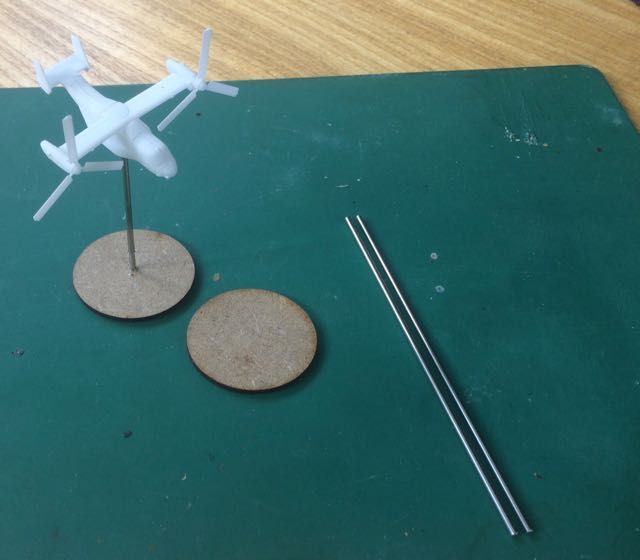
  • Air Bases.  For aircraft I originally kicked off with the idea of using Coresec bases which are very good but a bit big for 1/350 aircraft which is what I am currently intending to use for the aircraft scale.  Wire always strikes me as having potential for getting bent over time, even in reasonably heavy gauges. So I have gone for 2mm stainless steel rods, very strong and a challenge to cut, they need a vice, a pair of bolt cutters and a spare hand but do look very good. I have mounted these in 40mm diameter round bases using a 2mm drill bit and contact adhesive, then the base is prepared as either a land or sea base depending on aircraft role.


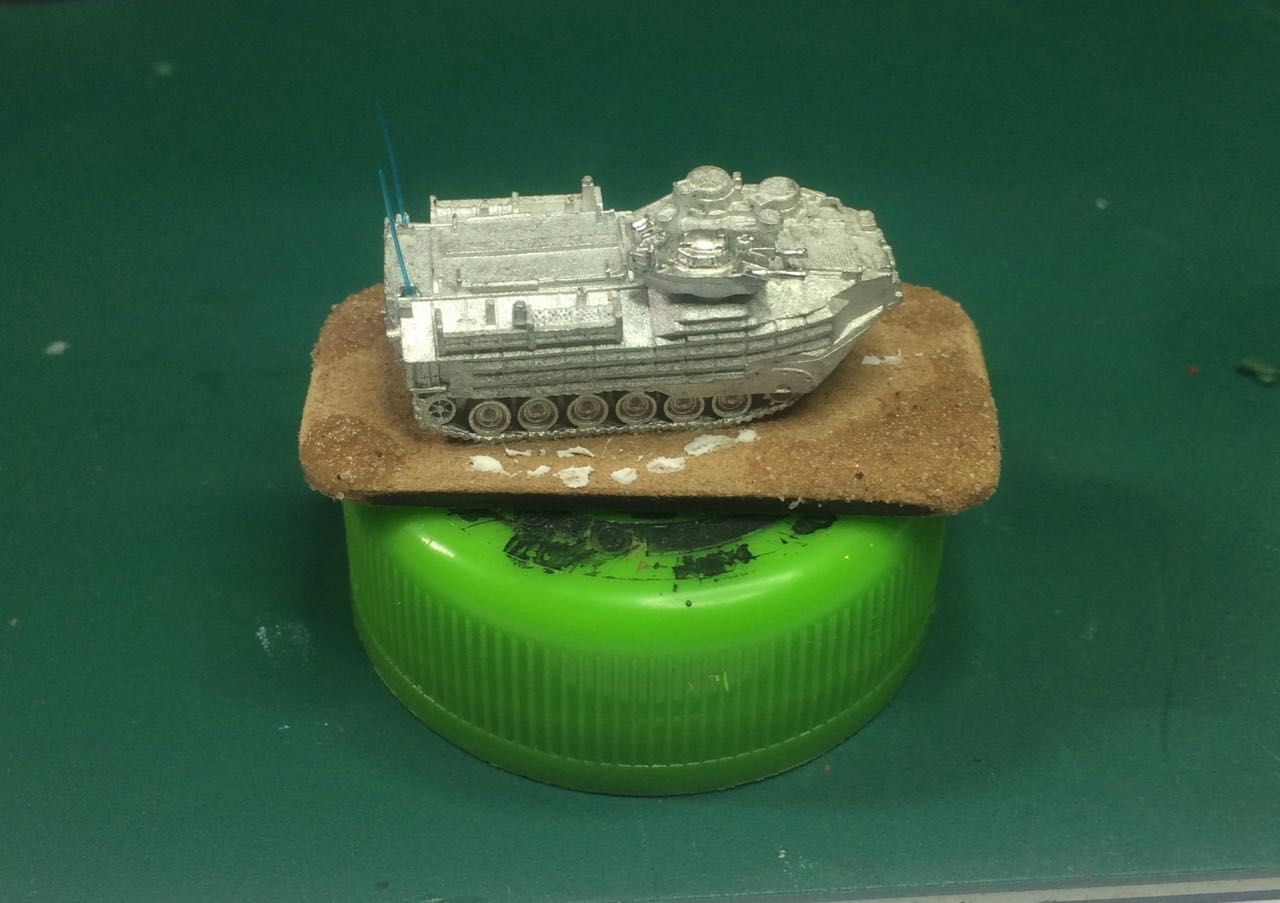
Assembly and Production.  I use the following assembly sequence to put the model and their bases together, which broadly follows the following sequence:
  • Stage 1
    • Modify base, Round corners, chamfer edges sand the surface with sandpaper to roughen dirt areas
    • Attach vehicles/figures
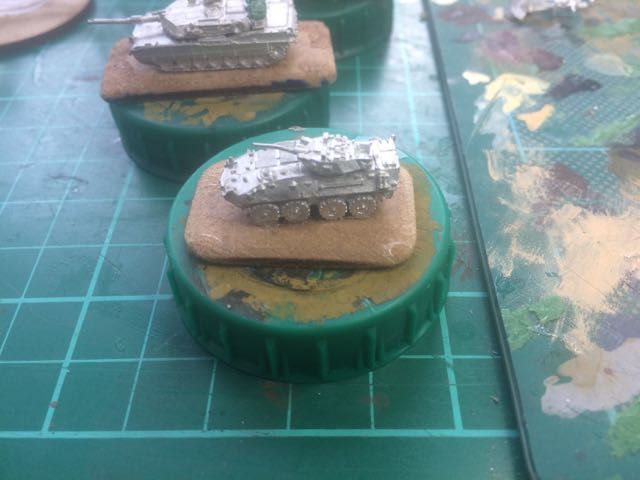
    • Attach based vehicle to painting support (I use plastic bottle lids)
  • Stage 2
    • Apply sand to base to represent grass areas, layer and seal on completion with white glue
    • Stow Vehicles when base dry
    • Prime with white primer
  • Stage 3
    • Paint Vehicles/Figures
    • Paint Dirt and Grass
  • Stage 4
    • Add Scatter Material
    • Paint Scatter material as required

Painting Technique. For 6mm I have been developing a painting style similar in approach to water colour painting.  This uses thin coats of colour on top of white primed bases and models and alternates this with black or dark brown washes using comercial washes. The thin coats of paint are always thin enough to be translucent. Care needs to be taken to not overload the brush.
  • Land Bases I start with a wash of black on grass and brown on the dirt surface, which helps me see. This is then followed by a thin application of the base colour and a follow on black brown wash. Depending on the level of surface texture this is then finished with either dry-brushing or washes of lighter shades of the base colour covering a reducing proportion of the area to be painted leaving the dark edges exposed.  The effect can be enhanced on completion with a final wash around the edge and any raised features on completion.
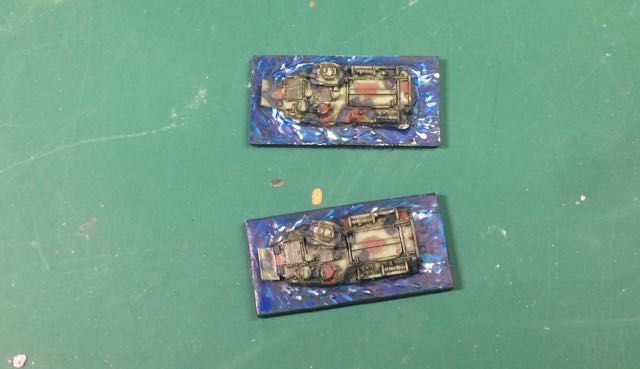
  • Sea Bases, I start with a pre-shade of black grey applied to selected areas, I then wash with medium blue followed by adding highlights in blue green before another wash of medium blue and a wash of dark grey.  This is repeated until the required effect is achieved, broken water is picked out in white. 


South East Asia Basing Colour Scheme.  For The areas of interest around the Pacific and the South and East China seas I am currently using the following colour schemes for the bases.
  • Land
    • Black Wash- Citadel Nuln Oil
    • Brown Wash - Citadel Agrax Earthshade
    • Grass Base - Vallejo, Model Colour 70893, US Dark Green
    • Grass Highlight one - Vallejo, Model Colour 70967, Olive Green
    • Grass High Light two - Vallejo, Model Colour 70857, Golden Olive
    • Foliage Shadow - Citadel Nuln Oil
    • Dirt Base - Vallejo, Model Colour 70880, Khaki Grey
    • Dirt High light - Vallejo, Model Colour 70976, Buff
  • Sea
    • Water Dark areas- Vallejo, Model Colour 70852, Black Grey
    • Water Light Areas - Vallejo, Model Colour 70808, Blue Green
    • Water Surface Wash - Vallejo, Model Colour 70963, Medium Blue
    • Broken Water - Vallejo, Model Colour 70951 White
If you have any ideas or tips you would like to share please do so in the comments section or on the Coldwargamer facebook page.

Note: I am updating this as I develop the techniques, additional material has been added on aircraft bases and the construction of the infantry movement trays, since the original post was published


Saturday, 22 September 2018

Modelling - Stowing USMC vehicles in 6mm


Vehicles in most armies carry a degree of external stowage and there always seems to be more of it when they are on operations rather than exercises, I suspect because ammunition load outs always take up more space when you are expecting to have to fight. The USMC seem to embrace external stowage to the full and pictures of their vehicles from recent deployments nearly always carry an amount of external load.


Having built one USMC force in 20mm I was used to loading their wagons with all sorts of stowage to match the images seen on the web, in the press and my somewhat vivid imagination.  In the land of 6mm, I was not exactly surprised to find that there were limited product ranges out there for representing external stowage and a lot of the techniques I had used for Cam nets and other items looked like they might be of less use in this scale.


One of the great things about 6mm, of which I am rapidly discovering there are many, is that 1mm represents a foot, so it's relatively easy to work out how big the stuff needs to be to fit on the model even for the mathematically challenged like myself.  The other great thing about 6mm is that very small things can be represented by very simple shapes and still look good, although I am generally of the opinion that you need to keep the objects of a fairly consistent size and shape if they are to be credible. Other than that its largely a question of colouring them in.


What Stowage and How to Make it
The ideas I have had to date are based on what one might consider to be common stowage items and the size they need to be, and how I have currently approached be representing them.

  • Crew - Chopped Figures, prone figures with Binos, turned out to be very good, green stuff hatches added to their backs round them out.


  • Radio Antenna, 2-3m long so 6 - 12mm, I went for tooth brush bristles, which are pretty thin virtually indestructible and don't put holes in your fingers.
  • Boxes - Various shapes and sizes from 10-12 inches for ammo cans through to 3-4 feet for ration cartons and large calibre ammunition crates, I went for plastic strip in a variety of thickness and widths, cut to an appropriate length enabling me to easily create multiple consistent boxes.
  • Rucksacks, I started with green stuff but in order to get a consistent size and shape switched to plasticard 3mm wide x .25mm thick (ish) which I cut in to 2mm strips then bulked out with Vallejo plastic putty, which is great for all sorts of bits in this scale, if you want something pipe it.

  • Roll Matts, .5mm plastic rod or brass rod cut to 2mm-3mm length, plastic rods better as you get square ends.

  • Grease Cans 1mm - 1.5mm plastic rod cut to 2 - 2.5mm lengths
  • Rubbish Sacks, piped with vallejo plastic putty
  • Sleeping Bags, green stuff or Vallejo plastic putty
  • Tarpaulins, green stuff
  • Cam Nets, green stuff, rolled to the approximate thickness required, then applied to vehicle, trimmed to size, pulled and pushed to make it look like its hanging from ties, then textured using a sharp point and a knife blade, ideally dipped in water to stop the green stuff adhering to the instrument of choice.
  • Air ID Marker Panels, I believe the US ones are modular and can also be folded so anything from a small square to a strip 2mm x 6mm. I use tin foil.

  • Flags - Tin Foil cut to size
  • Crew served and individual weapons - trimmed from figures, yet to really give this a go
  • Wheels - I think Heroics and Ross do some but I have yet to get my hands on any
  • Jerry Cans - I gave up :), any one knows of any let me know.


Where To Stick It

The important thing to bear in mind when stowing any vehicle is that it is a working machine:
  • Bits of it are hot, 
  • Bits of it move, 
  • Hatches, panels and turrets need to be accessible and able to function to allow entry exit and access for maintenance.
  • Air needs to circulate through engine grills to cool engines.  
Most of these places are best avoided and therefore the space on the vehicle to stow things is actually fairly limited.  Having said all that sometimes you have to pack in a hurry so there will always be the odd exception but as a general rule most crews will stow there wagons in a way that does not impair there ability to fight and maintain the vehicle.


Friday, 21 September 2018

Dragon Risen this time in 6mm


Its a few years since I did anything with this project.  I started gaming ultra modern around 2009 primarily building US expeditionary forces which included a US Army Strkyer Battalion and a USMC MEU in 20mm, when I started the opposition were mainly insurgents in Iran and Afghanistan. Dragon Rising kicked off around 4 years later when I wanted to examine the Pivot to the Pacific and possible future conflict with China in and around the South and East China seas which seemed to offer some interesting scenario options along with fledgling ranges of figures and vehicles from S Models, Elhiem, S&S and the Hobby den.  Sadly despite the success of some notable Chinese model makers such as Trumpeter and Modelcollect the 20mm options on modern Chinese equipments were and still are very limited particularly in the field of IFVs, APCs and Self Propelled Guns.


The theatre and potential flash points still interest me and there is a lot of information available on the web for those interested in  modern/ultra modern/near future and what if scenarios involving a variety of players in the region.  So I decided it was time to kick things off again but due to the limitations outlined in 20mm I decided to look to look at other scales which might better support both the period and the theatre.


It didn't take long to whittle the choice down to something around 6mm:
  • Good representation of AFVs from all the major regional players
  • Good representation of Aircraft and Helicopters
  • Brilliant representation of Naval Assets at a size that can be accomodated
  • A rich selection of terrain options, although more limited than 20mm a lot more easy to manage
  • some good rule sets accommodating the major players and equipment.
  • and a significantly reduced storage footprint, essential given the size of some of my 20mm projects.


So here I am, embarking on the second 6mm adventure of my life although the last was around 40 years ago.  It was good to see that all the manufacturers I was familiar with then are still going strong today.  I am kicking the Project off with some US force options.


The first will be the US Marines and US Navy with a focus on over the beach operations, followed I suspect by some OPFOR (Chinese) and then some US ARMY representation with a Stryker battalion. All that will need to run along side some serious terrain production.


The Pacific theatre both in WW2 and today is mostly wet, and Naval elements play a dominant role,  ultimately my interest lies in the Land battle but I think this needs to be set in the context of the Naval operations which have tended to dominate the recent history of the region. I have kicked off the purchasing and will be following this post with something on the composition of USMC Marine Air Ground Task Forces with a specific focus on the Marine Expeditionary Unit Special Operations Capable and its associated Naval assets.  In addition to that I will share my experiences in building the force, if only to record what I do so I don't forget, hopefully people who read this will find it useful.  


Friday, 4 October 2013

Review - Web Resources, Air Power Australia


I found this web site a year or so ago and use it extensively for information on Cold War Soviet Air Defence Systems. In addition to Its excellent coverage of both aircraft and air defence systems with some very well researched and analysed articles and imagery including either satellite or air photos of air defence installations. It also provides some really useful information on the PLA, their Air Defence systems and the organisation and deployment of those systems in units and formations as well as technical evaluations of their performance. Coverage Includes:
They also produce a lot of excellent articles covering the forces of the Pacific Rim, and the accelerating arms race that is developing within the region along with some useful contextual information on aspects of the strategic situation. If your into the technology it covers that off at a level of detail, and has some superb articles Including an Historical section that has some great pictures of current Australian military vehicles.

The web site offers an open and independent source of information primarily on Air and Air Defence topics with a mass of data that will be of interest to the Dragon Rising, Bear Resurgent gaming community and to those historically interested in the Region or Air Defence in general. Just what the Internet was made for really, sharing.